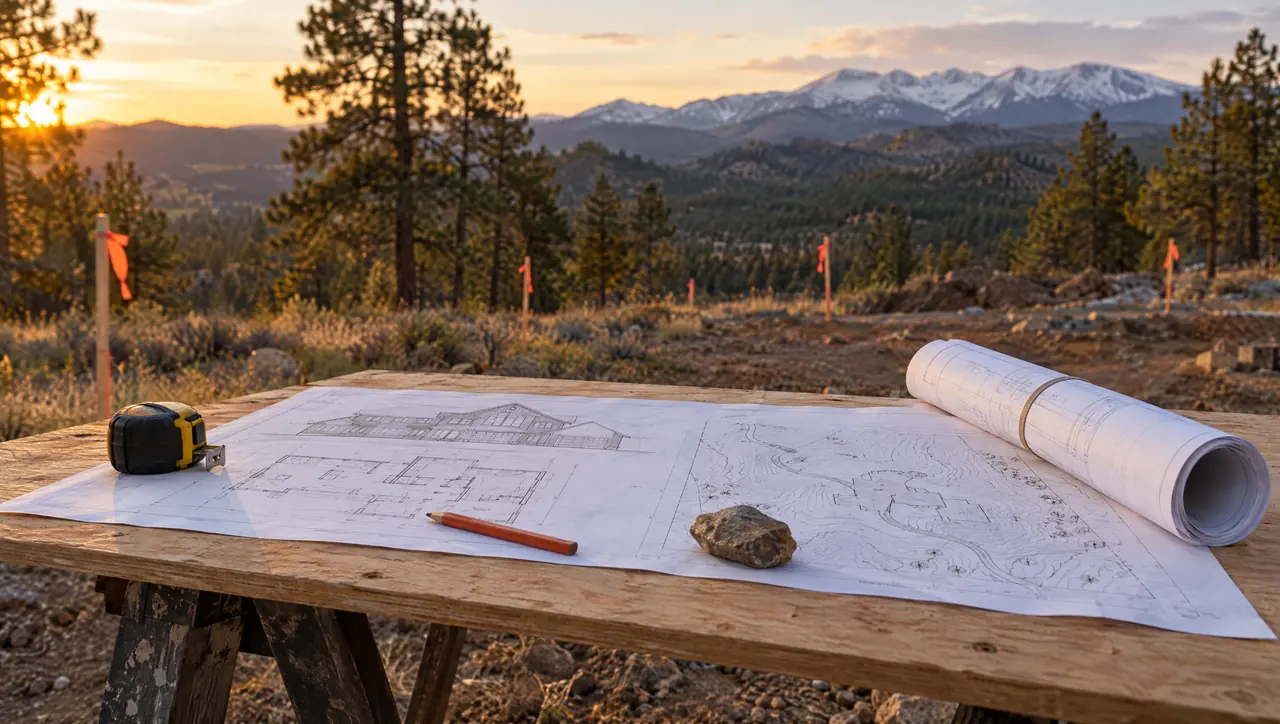
Before you build a custom home in Colorado.
A practical guide to the land, the budget, the design team and the questions worth asking before anything gets drawn.
Start with the right questions
Four early decisions shape everything after.
Custom homes rarely go wrong in the framing. They go wrong months earlier, when a lot was bought without checking the soil or a design was drawn without a budget. This guide is about getting those first decisions right.
The first four
Land, budget, team and priorities.
None need final answers yet. Each needs a working answer before design starts.
-
The land
The lot sets the foundation, the driveway, the utilities and much of the site cost. If you're still looking, compare lots on those terms as well as on the view. If you have one under contract, use the due diligence period to answer them.
-
The budget range
Decide the total you're comfortable with, including land, site work, design fees and a contingency. A design drawn to a number stays close to it. A design drawn first and priced later usually has to be cut back.
-
The design team
Decide who will draw the house: an architect, a residential designer, or a design-build arrangement. The comparison below lays out how they differ. What matters most is that the designer and builder talk early.
-
The priorities
Write down the three or four things the house must get right. A main-floor bedroom, a quiet office, a shop, a view to the west. When budget or space forces a choice, this list makes it for you.
Checking a lot before you commit
Most of what makes a lot expensive to build on is invisible from the road. Before buying, or during the contract's due diligence period, gather these:
- A boundary and topographic survey, showing property lines, easements and slope.
- A soils or geotechnical report, or at least what nearby builds found.
- Utility availability: water or well permit, sewer or septic feasibility, power and gas.
- Zoning setbacks, height limits and any covenants or design review board rules.
- Driveway access, including fire district requirements for width, grade and turnaround.
- Whether the lot sits in a wildfire or flood hazard area. Our page on building in Colorado explains why these matter.
Where a custom home budget goes
First budgets tend to focus on the house. The categories around it are where surprises come from.
| Category | What it covers | Often overlooked |
|---|---|---|
| Land | Purchase price and closing costs | Survey and soils report before purchase |
| Site work | Excavation, grading, driveway, utility connections | Well, septic and long utility runs on rural lots |
| Design and engineering | Architectural drawings, structural engineering | Revisions after a first round of pricing |
| Permits and fees | Building permit and plan review | Water and sewer tap fees, impact fees |
| Construction | Foundation through finishes | Upgrades chosen during selections |
| Outside the house | Landscaping, fencing, outbuildings | Defensible-space work on wildfire lots |
| Contingency | A reserve for the unknown | Leaving it out entirely |
Choosing how the house gets designed
There are three common routes. None is right for everyone.
| Architect | Residential designer | Design-build | |
|---|---|---|---|
| Who draws the plans | A licensed architect | A designer who may not hold an architect's license | A designer working inside or alongside the building team |
| Contracts | Separate contracts for design and construction | Separate contracts for design and construction | Often one contract covering both |
| A good fit when | The design is complex or the site is demanding | The brief is clear and the site is straightforward | You want one point of responsibility |
Fixed price or cost-plus
Custom home contracts usually take one of two shapes. Under a fixed-price contract, the builder commits to a price for a defined scope, and changes are priced separately. Under a cost-plus contract, you pay the actual costs plus an agreed fee, which keeps things flexible but moves more of the price risk to you. Either can work well. What matters is that you understand how allowances, changes and unexpected site conditions are handled before you sign.
Ask anyone you're considering
Questions to ask any custom builder.
Including us. Good builders welcome these, and the answers tell you a lot about how the next year will go.
Licensing and insurance
Colorado doesn't license general contractors at the state level, but many cities and counties do. Ask which local licenses the builder holds where you plan to build, and ask for proof of insurance.
Allowances
Which selections are covered by allowances, how were the amounts set, and what happens when a choice comes in above or below them?
Changes
How are changes requested, priced and approved? Is every change put in writing before the work happens?
Communication
How often will you hear about progress, from whom, and in what form? Who do you call when something looks wrong?
After move-in
What does the written warranty cover, for how long, and how are warranty requests handled?
What to bring to a first conversation
None of this needs to be polished. A phone photo of a sketch is plenty.
- The lot address or listing, and any survey or soils report you have.
- Your working budget range, including land if you haven't bought yet.
- Your short list of priorities.
- Photos of homes, rooms or details you like, and a few you don't.
- Drawings or notes from an architect or designer, if you're working with one.
- When you'd ideally like to move in.
Planning questions
What people ask before they build.
How much does a custom home cost in Colorado?
It depends heavily on the site, the size of the house and the level of finish, and site work alone varies widely between an in-town lot and a mountain one. A meaningful range comes after the brief and a look at the specific lot. Be wary of any per-square-foot figure quoted before either exists.
How long does it take to build a custom home?
The timeline depends on how far design has progressed, the permit review times in your jurisdiction, the complexity of the site and the weather. Design and permitting often take a substantial share of the total time before construction starts. Ask your building department for its current review times.
Do I need to own land before talking to a builder?
No. Talking before you buy can be useful, because a lot's soils, slope, access and utilities affect cost as much as the house does. If you have a lot under contract, the due diligence period is a good time to ask those questions.
Can I bring my own architect?
Yes. Many custom homes start with an architect or designer the owner already works with. Involving the builder early keeps design decisions and construction realities in the same conversation.
Ready when you are
Rough answers are enough to start.
Send what you have on the four decisions above, and we'll use the first conversation to fill in the gaps together.