Building a custom home on your own lot in Colorado.
Already own land, or have a lot under contract? Here's how to find out what it will ask of the house before design starts.
Start with the land
Own the land already? Start with what's under it.
A lot's price covers the ground. What it costs to build on that ground depends on things you can't see from the road: soil, slope, utilities, access and the rules that apply. On the Front Range those can vary from one parcel to the next, even on the same road.
What to look at first
Six things that decide what a lot costs to build on.
Boundaries and slope
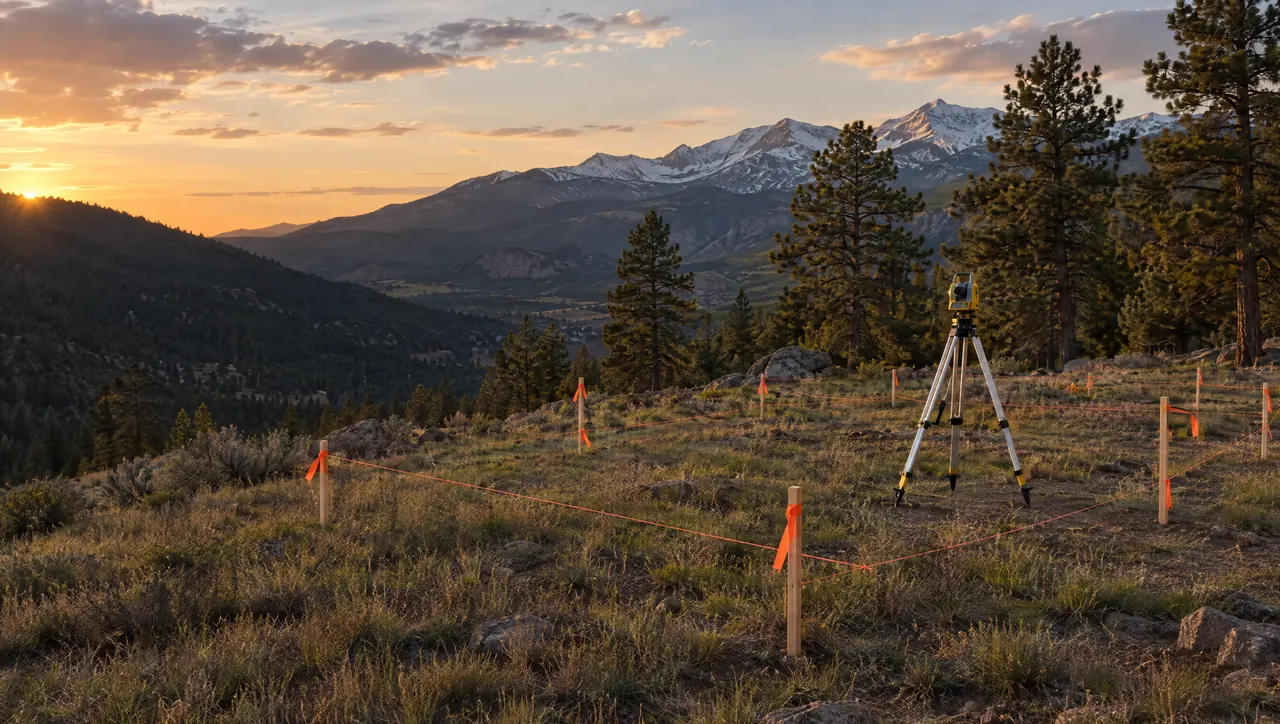
A current survey shows where the lot lines and easements actually are, and how the ground falls. Slope drives excavation, retaining walls and how the house meets the land.
Soils
Front Range soils can swell when wet, and bedrock can sit close to the surface. The geotechnical report tells the engineer which foundation the lot needs.
Utilities
Water, sewer, power and gas can be at the lot line or a long way off. On rural land, a well and septic system replace city services, each with its own permit.
Access
Fire districts set driveway rules, and every concrete, lumber and crane delivery needs a route in. Steep or long driveways add cost before the house starts.
Rules on the land
Zoning, setbacks, height limits and covenants define the space a house can occupy. Design review boards add their own approval step.
Hazards
Floodplains, wildfire areas and, in a few places, old mine workings can add requirements or rule out parts of a lot.
Interactive checklist
How ready is your lot?
Answer what you can. Anything marked no or not sure becomes a next step below. Nothing you enter leaves this page.
Know your lot type
Four kinds of lots, four sets of questions.
| City infill | Subdivision lot | Rural acreage | Mountain lot | |
|---|---|---|---|---|
| Utilities | Usually in place | Usually stubbed to the lot | Often well and septic | Often well and septic |
| Common extra work | Demolition, tight logistics | Design review approval | Driveway, utility runs | Excavation, retaining walls |
| Key question | What does zoning allow? | What do the covenants require? | Where does the water come from? | Can trucks and fire engines reach it? |
Questions
Building on your own lot: questions.
Can I build a custom home on a lot I've owned for years?
Usually, but check what has changed since you bought it. Zoning, building codes, wildfire rules, utility availability and tap fees all get updated, and an older survey may not show current easements. A fresh look at those items is the first step.
What if my lot has no utilities yet?
It can still be buildable. Water may come from a well or a new tap, wastewater from a septic system, and power from a line extension. Each has a cost and a permit, so price them before design so the budget isn't surprised later.
Do I need a new survey if I already have a plat?
Almost always. A plat shows how land was divided, but it doesn't show current topography, trees, improvements or the exact corners on the ground. Designers and engineers work from a boundary and topographic survey of the lot as it is now.
Have a lot?
Send the address. We'll start with the site.
Share whatever you have, whether that's a survey, a listing or just a pin on a map. The checklist above is a good place to start.