A soils report is the first document that tells you what's under your lot, and on the Front Range that answer drives the foundation design more than almost anything else. Many of the clays here swell when they get wet and shrink as they dry, and some sit on claystone bedrock that behaves the same way. A house designed without accounting for that can crack, heave or settle. The report is how your engineer and builder avoid guessing.
If you're closing on land this fall, it helps to know what the report contains and what to ask about each part. Here's the order most owners read one in.
Who writes it, and when
A geotechnical engineer prepares the report after drilling test borings on the lot and sending soil samples to a lab. Some subdivisions already have a preliminary report that covers the whole development. That's useful when you're deciding whether to buy, but it isn't a substitute for a site-specific investigation once you know where the house will sit, because soil can change over a short distance.
What to ask: is there an existing report for the subdivision, how old is it, and will the engineer drill where the house will actually go?
The project description
The opening pages restate what the engineer was told: the lot, the planned house, whether there's a basement, and roughly where it sits. Read this part closely. The recommendations are only as good as the assumptions behind them. If the plan has changed since the drilling (a walkout basement instead of a crawlspace, a house moved up the slope), the engineer needs to know.
What to ask: does the report describe the house we're building now?
Boring logs and groundwater
Each boring gets a log showing what the drill found at each depth: fill, sandy clay, claystone, gravel, and where bedrock starts. The logs also note whether groundwater showed up in the hole, either while drilling or when someone checked it again later.
Groundwater matters most if you want a basement. Water near the planned floor level can mean a more involved drain system, a different foundation, or raising the house. And one reading is a snapshot. Levels can rise in spring and after a wet season.
What to ask: how deep was the water, when was it measured, and does it change the basement we want?
Laboratory results
This is the section most owners skip, and it's the one that explains everything after it. The lab tests samples for moisture content, density and, most important on the Front Range, swell. A swell-consolidation test wets a sample under a set load and measures whether it expands or compresses. Those results tell the engineer how hard the soil could push on a foundation when its moisture changes.
Many reports also test for water-soluble sulfates. Sulfates in soil can attack ordinary concrete over time, so a high result usually comes with a recommendation for sulfate-resistant cement.
What to ask: how expansive is the soil at the depth the foundation will sit, and do the sulfate results change the concrete?
Foundation recommendations
Here the engineer turns the data into options. On stable soil that can mean conventional spread footings. Where swell is higher, the recommendations often call for drilled piers that reach deeper, steadier material, or for digging out a layer of expansive soil under the footprint and replacing it with compacted, engineered fill. You'll see design numbers in this section too, such as allowable bearing pressure and, for piers, minimum depths and loads.
Your structural engineer designs the foundation from this section, and many Front Range building departments require an engineered foundation design for a new house. The soils report is where that design starts.
What to ask: which foundation types suit this lot, and how do they compare on cost and schedule?
Floor systems
A basement slab sits right on the soil, so it moves when the soil does. On highly expansive sites, engineers often recommend a structural floor instead: a framed floor spanning a crawlspace, so the ground can swell without lifting the floor. Some reports allow a slab with specific details, like separating it from the walls and building interior partitions so they can slip, along with a plain statement of the movement risk the owner is accepting.
What to ask: is a slab basement floor reasonable here, and if so, how much movement should we expect?
Drainage, grading and backfill
Water is what sets expansive soil in motion, so a good report spends real space on keeping water away from the foundation: perimeter drains, how far the ground should slope away from the house, where downspouts discharge, how backfill gets placed and compacted, and how close to the walls irrigated planting can go.
These recommendations outlast construction. They're also the ones that get undone years later, when a new flower bed goes in against the foundation or a sprinkler head ends up aimed at a wall.
What to ask: what drainage and landscaping rules do we need to keep for as long as we own the house?
Looking at the open excavation
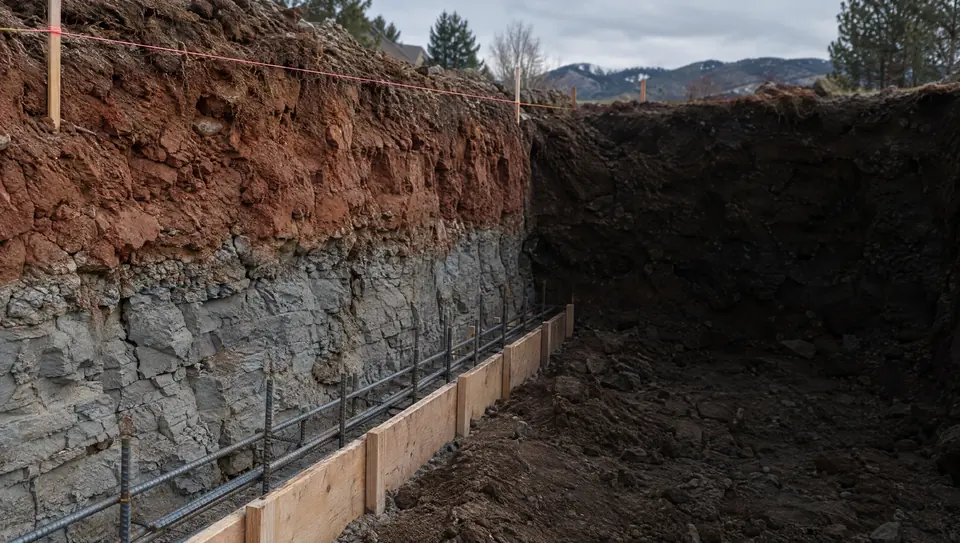
Most Colorado reports ask for the engineer, or someone working for them, to look at the excavation before footings are formed or piers are drilled. Borings only sample a few spots. The open hole shows the whole footprint, and if the soil differs from what the borings found, the recommendations can change before any concrete goes in, while changes are still simple.
What to ask: who does this observation, and how does it fit into the construction schedule?
Reading it before you buy
A soils report won't make a lot good or bad on its own. It tells you what it will take to build well there, and that affects the budget and sometimes the design. If you're still deciding on land, our guide to evaluating a Front Range lot covers the other checks worth doing, and building in Colorado explains how soil fits alongside snow, wildfire and radon. For the order to tackle everything in, start with before you build.
The Colorado Geological Survey publishes general information about swelling soils if you'd like background before you meet with an engineer. And if you'd like a builder to go through your report with you, tell us about the lot.